Meet the Fixers at the Back: How Stoke's Sound Techs Make Awkward Rooms Sing
Photo: Sgroey, CC BY-SA 4.0, via Wikimedia Commons
Walk into a gig in Hanley and you'll see the band. You'll see the bar staff, the door person, the mate holding the merch tin. What you might not see is the person at the back desk, crouched over a borrowed mixing console, coaxing a vocal out of a room that was built for something else entirely. In Stoke-on-Trent, that person is often the difference between a night that lands and a night that leaves everyone squinting.
Sound engineers are the fifth member of the band, except they don't get a soundcheck photo and they rarely get named on the flyer. They are part of the city's cultural infrastructure — as much as the stages, the promoters and the late-night buses. And in 2026, with more small rooms opening their doors to live music, it's worth asking who is actually making them work.
The room gets a vote
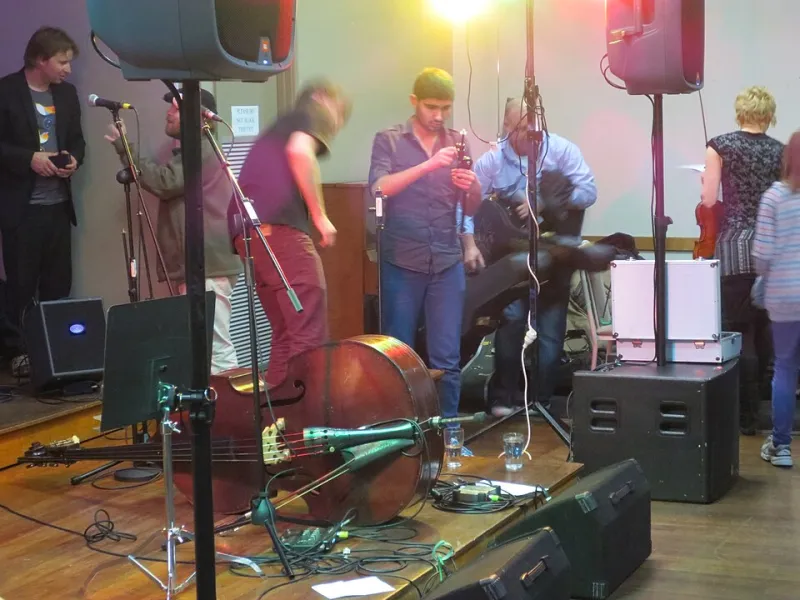
Stoke's venues are full of character and full of problems. Low ceilings swallow cymbals. Long narrow rooms bounce bass into the corners. A beautiful old bank building or a former working men's club can sound like a completely different place once 80 people are inside it. The person at the desk isn't just pushing faders; they're negotiating with architecture.
"You can't fight a room," says Ellie Brassington, a freelance engineer who has spent the past few years working across Burslem and Hanley. "You can only persuade it. Some nights that means turning things down. Some nights it means moving the drums two feet to the left. The best gigs are the ones where nobody notices the PA at all."
That invisibility is the point. When it works, the audience hears the band, not the system. When it fails, everyone hears the system.
Ellie Brassington: the borrowed van and the house desk
Brassington came up through local open-mic nights and a lot of unpaid favours. She now works regularly as a house engineer in a mid-sized Hanley venue and freelances for touring acts who need someone who knows the room before they've even loaded in. Her kit lives in a borrowed van and a spare room in Tunstall. She is, by her own admission, a fixer.
"A lot of the job is diplomacy," she says. "You've got a band who've driven three hours, a promoter who's worried about the door, a bar manager who wants the music off by eleven. You're trying to make everyone happy and also make it sound good. The sound good bit is the bit people remember."
She reckons the city has more good engineers than it has good desks. That gap matters. A decent engineer on a modest PA will usually beat a brilliant PA with nobody at the controls.
Danny Okafor: the PA that lives in a Longton lock-up
Danny Okafor runs small gigs in Longton under a name he's changed twice because the first two didn't fit. He owns his own PA — a modest but well-chosen rig that lives in a lock-up and gets wheeled out for community halls, back rooms and the occasional brewery taproom. He learned on the job, mostly by breaking things and then fixing them.
"I started because nobody else would do it," he says. "We had a night and we had a band and we had no PA. So I bought one second-hand and watched a lot of videos. Now I'm the person people ring when they've got a room and no idea how to fill it."
Okafor's setup is not fancy. But he knows how to ring out monitors, how to stop a feedback loop before it becomes a comedy moment, and how to make a three-piece sound full in a space the size of a living room. He also knows the value of a printed running order and a soundcheck that starts on time — small things that make a big difference when the room is rented by the hour.
Sam Thorley: from youth club to monitor world
Sam Thorley is younger than most of the people he works for. He got his first proper go at a youth music project in the city, learning on a desk that had seen better days. That led to a college course, then to shadowing engineers at bigger venues, then to paid work. He now specialises in monitors — the mixes the band hear on stage — which is a job that requires patience, diplomacy and a very good memory for who likes what.
"Everyone thinks the front-of-house desk is the glamorous one," he says. "But if the band can't hear themselves, the gig is over before it starts. I like being the person who sorts that out. It's like solving a puzzle every night."
Thorley is exactly the kind of technician the city needs more of: local, trained, invested, and likely to stay if the work is there. The pipeline exists. But it's thin.
The pipeline is local, if you know where to look
Stoke-on-Trent College and local youth music organisations have been feeding people into live sound for years, often without much fanfare. The route is rarely linear. Someone starts by carrying cases, then learns to coil cables properly, then gets trusted with a support slot, then gets a paid night. The missing bit is often the middle — the stage where someone needs to be paid to learn rather than learning for free.
That's where funding and credit come in. A small venue that budgets for a sound engineer is not just buying a service; it's keeping a skill in the city. A promoter who names the engineer on the poster is not just being polite; they're showing that the job is a job. And a college course that keeps its doors open to local gigs is not just teaching; it's building a network.
Credit is a line on the poster, not a favour
There's a persistent idea that the person at the back desk is a technician, not a creative. But anyone who has heard a great band sound average in a bad room knows that's nonsense. The engineer shapes the night as surely as the lighting or the setlist. They deserve a name on the flyer, a fee that reflects their time, and a shout-out at the end.
In 2026, Stoke's live music scene is busy enough to support that. The small rooms are there. The audiences are there. The next step is treating the people who make those rooms sing as part of the infrastructure — not an afterthought with a headtorch.
So next time you're at a gig in the city, look to the back. The person hunched over the desk is probably the reason you can hear the words. Say hello. Buy them a drink. And when the poster goes up, make sure their name is on it.