The Room After the Room: Stoke's Gig Tapers and the Art of Saving a Night You'll Never Hear Again
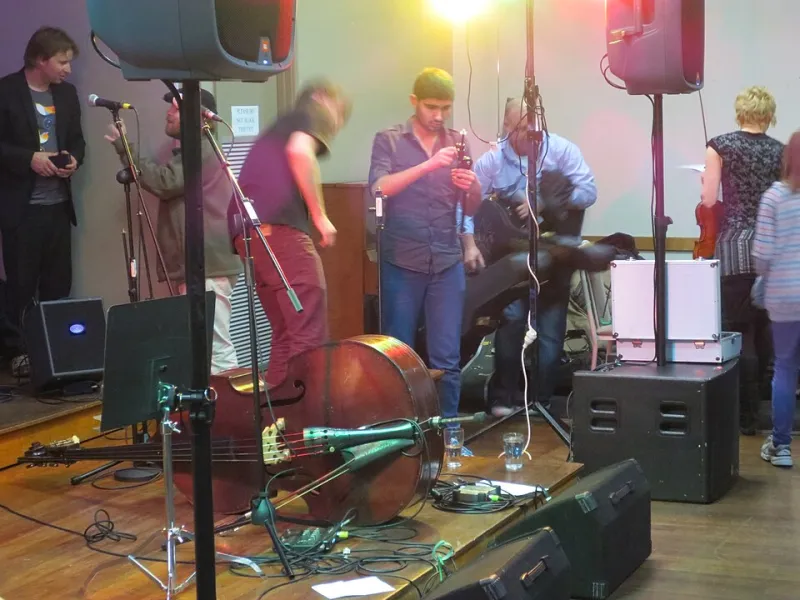
Photo: Johnscotaus, CC BY-SA 4.0, via Wikimedia Commons
On a wet Tuesday in Hanley, the band is halfway through a song that might not have a name yet, and there's a person by the pillar holding a phone very low, very still. They're not filming for a reel. They're taping. Or trying to, anyway, between the clink of glasses and a conversation near the bar that has somehow become part of the arrangement.
Stoke-on-Trent has always been a city that makes things, and in 2026 a small, mostly unorganised group of gig-goers is making something else: an audio record of the small rooms where the city's music scene actually happens. Some use phones. Some turn up with mics, a recorder and a rucksack full of batteries. None of them are official. All of them are trying to catch a night before it disappears into the same place as last month's setlists.
This isn't about surveillance, and it isn't about building a personal content pile. Done well, taping is closer to civic housekeeping: a way of noting what was played, who played it and what the room sounded like while it happened. Done badly, it's a phone held above someone's head for forty minutes. The difference is mostly consent and manners.
First, the permission bit
The first rule is boring and unavoidable: ask. Ask the artist before you record, and ask the venue too. Some musicians are delighted. Some are working on material they don't want circulating. Some have had a bad experience with a clip being pulled out of context. A yes for a private copy is not automatically a yes for a public upload, and a yes from the headline act is not a yes from the support act.
In Stoke's smaller rooms, the person on the door is often also the person who knows the house rules. If there's a no-recording sign, that's the answer. If you're unsure, ask the sound engineer as well as the band. If someone says no, put the phone away and enjoy the gig like everybody else. Taping is a guest behaviour, not a right.
Phone, rig or both?
Most of the recordings being made in the city right now are phone captures. That's fine. A phone in the right spot can catch the atmosphere of a room better than a clean desk recording ever will: the shuffle between songs, the laugh at a local reference, the moment the PA gives a little too much. The limits are obvious. Phone mics clip when the room gets loud, hands move, pockets rustle, and the person next to you becomes an uncredited backing vocalist.
Proper rigs are rarer but not mythical. A small recorder, a pair of mics and a clamp can do wonders in a back room in Burslem or Longton. The trick in a small venue is not to treat it like a concert hall. Keep levels low, avoid blocking sightlines, and don't plant yourself in the one spot where the sound is best if that's also where the crowd needs to move. A recording made from a slightly odd corner is still a recording. A recording made by ruining the gig for everyone around you is just bad manners with a windbreak.
The etiquette of standing still
A taper should be the least interesting person in the room. No flash. No screen held up like a torch. No tripod across a fire exit. No running to the front during the quiet song to check the levels. If the venue has a balcony or a back corner, use it. If the crowd is packed tight, don't make people climb around you.
It helps to remember that the recording is not the event. The event is the band, the room and the people who paid to be there. If someone asks you to stop, stop. If the artist signals that this one is off the record, off the record it is. The best tape in the world isn't worth being the person everyone remembers for the wrong reason.
What happens after the last note
The aftercare is where most recordings quietly die. A file called set.wav on a phone is not an archive. A useful recording needs a date, a venue, a lineup, a note on who gave permission and what that permission covers. It needs a backup in at least two places. And it needs a conversation with the artist before it goes anywhere public.
A good habit is to send the recording to the band first. Let them hear it, let them decide whether they want it shared, and let them say if the mix is too rough or the between-song chat is too personal. Some will want the whole thing out. Some will want a track or two. Some will want it kept private. All of those are valid. If a venue wants a copy for its own records, ask the band first. If you're putting together an index of local live recordings, keep it simple and keep it accurate.
The same goes for credit. Name the players, the room, the sound engineer if they're happy to be named, and the person who gave the nod. A recording with no context is just noise with a date attached.
Why imperfect documents matter
Stoke's cultural memory has a habit of being written down after the fact: the regeneration report, the heritage plaque, the photo of a building before it became flats. The small rooms don't always get that treatment. They close, they change hands, they become something else. The bands split up. The setlists go missing.
A phone recording with a bit of hiss and a glass dropped near the bar is not a perfect document. It's better than nothing. It tells you what a room sounded like in 2026, how long the sets were, what the between-song banter was, which new band was opening for which other new band. It's evidence that the city's nightlife isn't just an economy to be measured. It's a culture that happens in real time, in rooms that don't always make the official record.
That's why the taping habit is worth treating carefully. Not every gig needs to be captured. Not every recording needs to be published. But the ones that are made with permission, labelled properly and shared thoughtfully become part of how Stoke understands itself. The Potteries didn't just make pots. It made nights. Some of them are worth keeping.
A simple code for 2026
- Ask the artist and the venue before you record.
- Keep the rig small and the sightlines clear.
- No flash, no screens up, no blocking the aisle.
- Respect a no, even mid-set.
- Label the file with date, venue and lineup.
- Send a copy to the band before you share it.
- Back it up twice and keep a simple index.
- If in doubt, leave the phone down and just listen.
Stoke's small-room sound in 2026 doesn't need a grand archive project to survive. It needs a few people who know when to press record, when to stop, and what to do with the tape afterwards. The rest is just hiss, and hiss is part of the story.