Fuse, Blown: The Stoke Gigs That Keep Going When the Amps Die
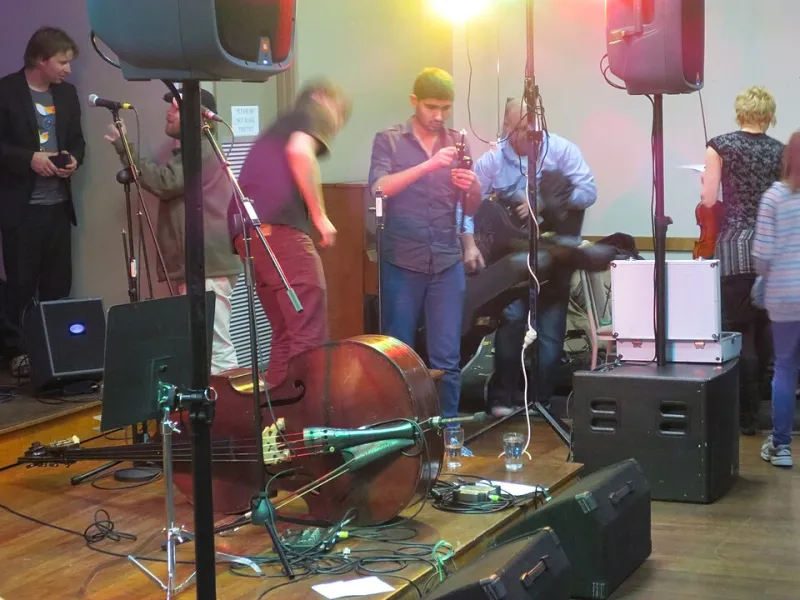
Photo: Johnscotaus, CC BY-SA 4.0, via Wikimedia Commons
There’s a particular Stoke sound that only happens when something breaks. The PA clicks off. The amps go dark. For half a second, the room holds its breath — then somebody at the back says “go on then,” and a gig turns into something else entirely.
That half-second is the subject here. Not the big civic power cuts that make the news, but the smaller failures that happen in back rooms, social clubs and upstairs venues across the city: a fuse blown by a tired extension lead, a bass amp that gives up halfway through the second song, a PA that shuts down because the room’s electrics are older than the setlist.
The first thirty seconds
The first thirty seconds after the sound dies tell you a lot about a room. In a bad venue, it’s chaos: bar staff shouting, a guitarist fiddling with leads, someone asking if the whole street has gone. In a good one, it’s almost choreographed. A sound tech reaches for a torch. The singer steps forward. The drummer keeps a beat on the snare, quietly, just to hold the space together.
“You can rehearse for it without ever planning it,” says a sound tech who has worked the Hanley and Burslem circuit for years. “Most of the job is knowing where the trip switch is and not making a drama out of it. If the room trusts you, they’ll wait. If they don’t, they’ll drift to the bar.”
A guitarist I spoke to remembers a night in a small Stoke venue when the power went mid-song. The band had one acoustic guitar in the van, half a drum kit still standing and no plan. They finished the set with the room singing the chorus louder than the PA ever managed.
“It was better than the plugged-in version,” they said. “Not because it was magical, but because everyone was in it together. You can’t buy that.”
The room is part of the instrument
Stoke’s small venues have always had to be resourceful. They’re often old buildings with character, questionable wiring and a bar that doubles as the green room. That means a power failure is not just a technical problem; it’s a social one. The room has to decide whether to wait, help or go home.
The best rooms keep a “dark box” behind the bar: spare fuses, a couple of extension leads, a torch that actually works, gaffer tape, and a battery-powered amp that has seen better days but still makes a noise. It’s not glamorous. It’s the difference between a night that ends early and a story people tell for years.
There’s also a quieter skill: knowing when to stop. If the failure is a blown fuse, it might be a five-minute fix. If it’s a problem with the building’s supply, carrying on with a battery amp and a singalong is brilliant for ten minutes and risky for thirty. Someone has to make the call.
Not every power cut is a folk tale
It’s tempting to romanticise the unplugged set. Candles, phone torches, a crowd in harmony — lovely. But the practical side matters. If the lights go out, can people get to the door? Is the cash tin secure? Are there people in the room who need to know what’s happening? A good night is an accessible night, even when the amps are off.
That’s why the best 2026 plan for small Stoke venues isn’t a grand emergency protocol. It’s a short checklist that everyone on the team knows:
- Keep a dark kit near the stage. Torch, spare fuses, gaffer tape, two extension leads, a printed contact list for the electrician and the landlord.
- Agree who announces what. One person, usually the promoter or sound tech, tells the room what’s happening and how long it might take.
- Have one acoustic option. A guitar, a small battery amp or even a keyboard with batteries. It doesn’t need to be perfect.
- Protect the door. If the night becomes a free singalong, decide quickly how refunds, re-entry and cash work.
- Check the exits. Phone torches are not emergency lighting. Know where the doors are and keep them clear.
For bands, the advice is simpler: learn one song that works with no PA. Not a ballad for the sake of it, but a song the room can hear and join if it wants to. Know which member can lead it. Keep a torch in the gig bag. And don’t apologise for the room — the audience can feel the difference between a band that’s embarrassed and a band that’s making the best of it.
The after-dark set
The unplanned acoustic set won’t save every night. Sometimes the power stays off, the crowd drifts, and the right thing is to call it. But when it works, it does something that a perfect, plugged-in gig rarely does: it makes the venue feel like a room full of people rather than a stage with an audience attached.
As Stoke heads into the darker months of 2026, with early doors and winter warmers on the calendar, that’s worth planning for. Not because we want the power to fail — but because the rooms that keep going are the ones that know how to look after the night when it does. Fuse, blown. Room, still full.