Clipboards, Cables and a Borrowed PA: What the Torch Relay Left Stoke's Street Gigs
There is a version of Stoke-on-Trent that only exists for a few hours at a time. It appears when a road closes, a stage goes up on a patch of tarmac that is normally a bus stop, and a few thousand people who would never otherwise stand in the same place decide to do exactly that. The city did it in the summer of 2012, when the Olympic torch came through, and it has been doing it, on and off, ever since. If you want to understand why this site is called Stoke 2012 Live, that afternoon is a decent place to start.
A city as a venue, for one afternoon
The torch relay arrived with a peculiar kind of energy. It was not a gig. There was no headline act, no door take, no wristband. What there was, instead, was programming: school choirs on temporary platforms, local bands on the back of a lorry, a brass ensemble near a shopping precinct, dance troupes in car parks. The route turned Hanley and the surrounding streets into a sequence of small stages, each one with its own sound problems and its own crowd.
What made it stick in the memory was not the flame. It was the sheer amount of ordinary civic machinery required to make a few hours of public celebration feel effortless. Barriers. Stewards. A volunteer with a clipboard telling another volunteer where the choir was supposed to be. Bunting. Bins. The unglamorous stuff that our piece on festival regeneration keeps circling back to, because it never really goes away.
The clipboard economy
Ask anyone who has helped run a street event in the Potteries and they will tell you the same thing: the day is won or lost on logistics, not line-ups. In 2012 that meant clipboards, radios that half-worked, and volunteers who had been briefed twice and were still improvising by eleven in the morning.
What the relay got right was volume. There were enough people on the ground to absorb the small failures — a late choir, a missing cable, a road that reopened ten minutes early. What it got wrong, at times, was retention. A lot of those volunteers had a brilliant day and then never came back, because nobody asked them again. That is the quiet lesson every one-dayer in Stoke has had to learn since: recruitment is easy, follow-up is hard.
The street gigs that now pop up around the city — the market sets, the courtyard sessions, the occasional closed-road knees-up — have largely solved this by going small and repeatable. Fewer stewards, more familiar faces. A mailing list that actually gets used. The clipboard is still there. It just belongs to someone who has done it four times before.
Sound in rooms with no walls
Outdoor sound is a different sport. Indoors, you fight the room. Outdoors, you fight the sky, the wind, the bus idling at the lights and the fact that the stage is facing the wrong way for the crowd that actually turned up.
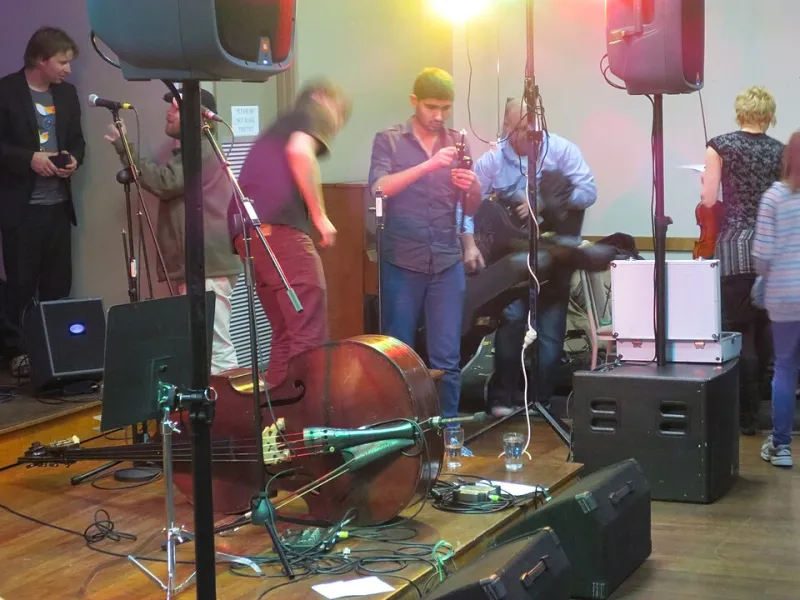
In 2012 the temporary stages were mostly functional rather than flattering. Vocals disappeared. Bass travelled. Anyone more than thirty metres back heard a kind of rhythmic suggestion rather than a song. It was fine — nobody had come for a hi-fi experience — but it taught local organisers a useful humility. If you are putting music in public space, you are programming for atmosphere as much as for audio.
You can hear that inheritance in 2026. The better street gigs in Stoke now book accordingly: acoustic acts early, louder bands when the crowd has thickened, and a sound tech who has walked the site before the first cable is laid. The ones that struggle are usually the ones that treated an open-air pitch like a small club with the roof taken off.
Crowd flow is a design problem
The torch relay was, unintentionally, a masterclass in moving people through a city that was not built for it. Narrow pavements, awkward junctions, a shopping centre that acts as a wind tunnel. The crowds were good-natured and largely self-organising, but the pinch points were obvious: anywhere the route narrowed, anywhere a stage sat too close to a crossing, anywhere a parent with a pushchair met a wall of people who had stopped to film something.
The street gigs that work best now treat flow as part of the show. They leave a gap. They put the merch table where it does not block the exit. They resist the urge to cram one more food van into a space that needs to stay clear. It is not glamorous, but it is the difference between a crowd that lingers and a crowd that quietly decides to go home.
What did not work
It would be dishonest to pretend 2012 was a flawless template. Some of the programming felt like it was booked for a brochure rather than a street. Some of the sound was genuinely poor. And the day depended heavily on goodwill rather than on any lasting infrastructure — which is why the city spent the next few years re-learning the same lessons at every new event.
But that is also the point. A one-dayer is not supposed to be permanent. It is supposed to be a rehearsal for a city that wants to keep putting music in public space. The torch relay was a very large, very visible rehearsal. Everything since has been a smaller, more sustainable version of the same idea.
Why the name still fits
Stoke 2012 Live is not an archive of one afternoon. It is a nod to the moment a lot of people in this city realised that a street, a precinct or a car park could hold a crowd if you gave it a reason. The torch came through, the roads closed, the choirs sang, and then it was over. What stayed was the instinct to do it again.
Fourteen years on, the best street gigs in Stoke-on-Trent are still running on that instinct — and on a clipboard, a borrowed PA and someone who knows where the bins go. That is not a bad legacy for a single day in the summer of 2012.