Where the Set Starts Before the Stage: Stoke's Improvised Green Rooms
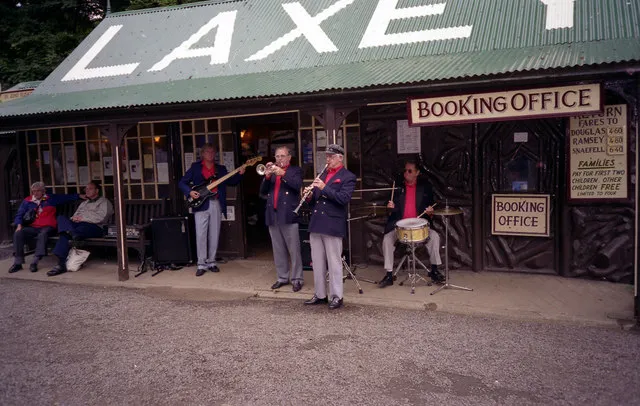
Photo: Dr Neil Clifton, CC BY-SA 2.0, via Wikimedia Commons
On a wet November night in Hanley, the door marked PRIVATE opens onto a corridor barely wide enough for a guitar case. A singer is doing scales under her breath. The drummer is sitting on an upturned crate, taping a setlist to his knee. Somewhere behind them, a fridge hums in a pub kitchen that doubles as a dressing room. This is the green room in a lot of Stoke gigs: not a room at all, but a slice of borrowed space where the night gets its act together.
It is easy to think of backstage as a mystery. In reality, for most bands playing the city's smaller venues, it is a geography of corridors, storage cupboards, staff toilets, unlit stairwells and the back seats of cars. The rituals that happen there — tuning, pacing, panicking, laughing, checking the door take for the third time — are as much a part of a Stoke show as the amps and the audience.
The geography of a borrowed green room
“We've played places where the green room was literally the corridor by the loos,” says Jess, a guitarist who has been gigging around the Potteries for years. “You learn to tune up quietly and get out of the way when someone needs the mop. It's not glamorous, but it does make you feel like you're part of the building rather than a visitor.”
Venue staff know this rhythm well. A promoter in Burslem describes the backstage area as “wherever we can put them without blocking a fire exit.” On busy nights, that might mean a corner behind the merch table, a side room normally used for storage, or the kitchen once service has finished. The smell of chips and cleaning spray becomes part of the warm-up. Bags are stacked against a wall. Someone hunts for a plug socket. A coat is thrown over a stack of crates.
For bands, the improvisation starts before they arrive. They ask where to load in, whether there is a safe place for cases, and if there is anywhere to sit. The answers are not always glamorous. “You get quite good at changing a guitar string on a windowsill,” says Cal, who plays in a local post-punk trio. “And you get very good at not knocking over someone's pint while you do it.”
Warm-up, panic, repeat
The warm-up itself is rarely a formal affair. Some musicians do vocal exercises in the car. Others walk around the block to settle their nerves. One drummer admits to practising paradiddles on his thighs in a pub corridor until a member of staff asks him to stop. A keyboard player says she runs through the first verse of each song in her head while queuing at the bar for water.
The corridor has its own acoustics. You can hear the support band finishing, the crowd shifting, the thud of the front door. It is both distracting and useful. “You can gauge the room from back there,” Jess says. “If it sounds busy, you relax a bit. If it sounds empty, you start doing that thing where you tell everyone it's still early.”
Promoters see the same patterns. “There's always one band who are ridiculously calm and one who are convinced the night is going to fall apart,” says a promoter who runs occasional gigs in Longton. “Usually they're in the same corridor, and by the end they've swapped energy. The calm one starts worrying about the door take and the panicker is ready to go on.”
The kitchen circuit
Some of Stoke's most memorable backstage areas are not designed for bands at all. A function room with a stack of chairs. A hallway with a boiler ticking. A kitchen where the setlist is propped against a tea urn. These spaces force a certain closeness. You cannot hide in a corner when the corner is full of coats and flight cases.
That closeness can build camaraderie. Bands share leads, tape, throat sweets and advice. A support act lends a tuner to the headliner. Someone holds a phone torch while a bass string is changed. The hierarchy of the bill flattens in a corridor. “You're all just people trying to get through the next forty minutes,” Cal says.
It can also be awkward. There is nowhere to have a private wobble. A singer might need a moment alone and find only a stairwell. A guitarist might want to warm up properly and end up playing unplugged to avoid annoying the bar staff. Yet many musicians say this is part of the city's character. The lack of polish is not a bug; it is the condition that makes the gig feel local and accountable.
Cars, corners and the decompression hour
The backstage story does not end when the band walks on. After the set, the corridor becomes a decompression chamber. There is merch to count, gear to pack down, congratulations to accept and the sudden drop in adrenaline to manage. Some musicians sit in the car for ten minutes before driving home. Others stand outside in the cold, buzzing, talking too fast.
“I need that bit of quiet after a gig,” Jess says. “If I go straight into a noisy bar, I'm useless. I'll be the person staring at a pint. A corridor or a car boot gives you a minute to come back down.”
For venue staff, the post-gig corridor is also a practical space: doors to lock, bins to move, lights to switch off. The best promoters build in a little time for it. They know that a band packing down in a cramped hallway is not a problem to be rushed; it is the last part of the show.
What cramped spaces teach a band
Stoke's improvised green rooms may not have mirrors or rider-friendly sofas, but they teach lessons that stick. Bands learn to prepare in small spaces, to respect shared areas and to make do. They learn that a set does not begin when the first chord lands; it begins when the car is parked and the case is opened.
They also learn how much of a gig is held together by other people: the promoter who finds a private corner, the bar staff who let a musician fill a water bottle, the friend who guards the merch while the singer paces. The city's music culture is often talked about in terms of venues and audiences. The corridor is part of that culture too — a reminder that the night is made in the margins.
So next time you see a door marked PRIVATE at a Stoke gig, listen for the quiet rituals behind it. The tuning. The nervous laugh. The muttered count-in. The set has already started.