The Noticeboard Was the Algorithm: Stoke's Photocopied Gig Flyers and the Art of Being Found
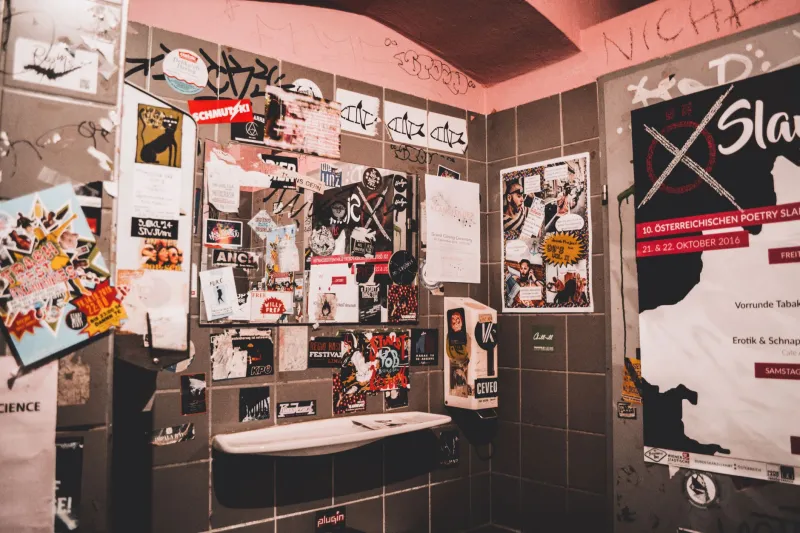
There is a particular shade of fluorescent orange that only exists on a photocopied gig flyer. It is not quite orange and not quite pink, and it fades to a dusty peach after a fortnight behind glass. In Stoke-on-Trent in 2012, that colour was everywhere: taped to the door of The Exchange, stapled to telegraph poles in Burslem, Blu-Tacked to the window of a record shop in Hanley. The flyers were cheap, crooked and often out of date by the time you read them. They were also a better map of the city's music scene than any listing site has managed since.
This is not a misty-eyed plea to bring back the past. It is an argument about what gets lost when a scene moves from the noticeboard to the feed. The 2012 flyer was made by someone who was in the room, for people who might be in the room next time. It carried the venue, the door time, the price and usually a mobile number. It did not ask you to sign up to anything. It just asked you to turn up.
The paper trail
I spent an afternoon with a shoebox of these things recently. They had been kept by a promoter who booked bands above a Hanley pub in 2012, and they were a mess in the best way: A6 slips for a three-band bill at a pub back room, A5 sheets for an all-dayer in a Burslem social club, a folded zine with a hand-drawn map of the city centre and a note that said 'bring a friend, bring a fiver'.
The promoter told me: 'We had no budget for ads. The flyer was the ad, the ticket, the souvenir and the proof that the night existed. If you saw one on a lamppost, you knew someone had actually gone out and put it there.' That is the key difference. A flyer is a physical act of promotion. It leaves a mark. It gets rained on. It gets corrected with a Sharpie when the support act changes. It is not optimised; it is alive.
The best 2012 flyers were not design classics. They were functional in a very local way. They told you the bus route. They told you whether the room was upstairs. They told you the curfew. One had a handwritten note: 'No dickheads, no flares, no exceptions.' Another had a drawing of a pint with the words 'cheap enough' underneath. These are not just graphics. They are a set of social instructions.
What the flyers got right
The 2012 flyer understood that most people do not plan their lives through a calendar. They find things by accident. They see a poster on the way to the shop, or a stack of cards on a bar, or a friend's hand-drawn recommendation. That is how local scenes grow: through repetition and proximity, not through reach and impressions.
Photocopied zines did the same job in longer form. They were part listings magazine, part gossip sheet, part manifesto. They ran interviews with bands who had played the same three venues as everyone else. They reviewed nights that had happened in rooms above shops. They were biased, messy and occasionally libellous. They were also proof that the city had a culture worth documenting.
The flyers also had a lower barrier to entry. You did not need a design degree or a marketing budget. You needed a photocopier, a marker pen and a reason. That meant the people promoting gigs were often the people playing them, or their mates, or the person who ran the door. The scene promoted itself because there was no one else to do it.
From Sellotape to the feed
None of this is to say that 2026 is worse. Digital listings are faster, more accessible and easier to update. A last-minute venue change can be shared in seconds. A band from out of town can find an audience without printing a single sheet. Social media has opened doors for promoters who could never have afforded a print run. That matters.
But the feed has its own weather. It rewards the loudest, the most frequent and the most polished. It hides the small night in the back room unless someone pays to boost it. It turns a gig into content, and content into a scroll. A flyer on a window can be seen by someone who was not looking for it. An Instagram story is only seen by people who already follow you.
The other loss is texture. A flyer tells you what the promoter thought was important: the price, the bus, the door time, the fact that the room is step-free. A digital listing often tells you what the platform thinks is important: a hero image, a ticket link, a share button. The practical stuff gets buried. The human stuff gets flattened.
Keep the Sharpie energy
There are signs that the city is finding a middle way. Promoters in Hanley and Burslem are running small print runs again, not because they are nostalgic but because a poster in a chip shop still works. Local designers are making flyers that look like flyers, with room for a QR code and a handwritten note. Community noticeboards are coming back into use in libraries and community centres. The best of these are not precious about it. They are using paper as one channel among many.
That is the lesson worth keeping from 2012. The point was never the paper. The point was that promotion was made by people who were in the room, for people who might be in the room next time. The point was that a gig should be findable by accident. The point was that a scene should leave a mark.
So print the flyer. Put the door time on it. Add the bus route. Correct it with a Sharpie when the lineup changes. Then post it online as well. The noticeboard was never the enemy of the algorithm. It was just a better place to start.